10 Years of UPI: Growth, Expansion, and Impact
The Unified Payments Interface (UPI), launched on April 11, 2016 by the National Payments Corporation of India (NPCI), has completed 10 years and has now become the backbone of India’s digital payments ecosystem.
UPI is a real-time digital payment system developed by NPCI. It enables instant fund transfers between bank accounts through a mobile-based interface, making digital payments simple, fast, and accessible to all.
Key Features
- UPI is a simple, secure, and real-time payment system.
- Users can send money using just a Virtual Payment Address (UPI ID), without needing bank account numbers or IFSC codes.
- It operates 24×7, allowing transactions at any time.
- It is interoperable—enabling seamless transactions across different banks and apps.
- It requires only a mobile phone, bank account, and secure authentication (PIN/OTP).
- It supports both P2P (Person-to-Person) and P2M (Person-to-Merchant) payments.
Growth & Expansion of UPI
- Transactions increased from 17.86 million (₹6,952 crore) in FY17 to 218.98 billion (approximately ₹285 lakh crore) in FY26.
- Monthly transaction value rose from ₹21 lakh crore in FY20 to nearly ₹30 lakh crore.
- Around 400 million active users, with 250 million daily and 450 million monthly users.
- Growth in AutoPay—around 100 million AutoPay mandates and 500 million monthly debits.
UPI Evolution
- UPI Lite: Made small transactions faster and simpler.
- UPI AutoPay: Enabled easy recurring payments like subscriptions, bills, and EMIs.
- Credit on UPI: Expanded access to loans through pre-approved credit lines.
→ These innovations have transformed UPI from a simple payment system into a comprehensive financial platform.
Global Recognition
- The IMF and World Bank have praised its efficiency and inclusiveness.
- UPI is now operational or linked in multiple countries:
UAE, Singapore, Bhutan, Nepal, Sri Lanka, France, Mauritius, Qatar, etc.
Government Initiatives
1. Policy Push
- JAM Trinity (Jan Dhan, Aadhaar, Mobile) laid the foundation for UPI.
- Promoted a less-cash economy.
- Direct Benefit Transfer (DBT) increased trust in digital payments.
2. Regulatory Support
- RBI ensured a secure, real-time, 24×7 system.
- Zero or low-cost model boosted adoption.
- Strong security and authentication frameworks were developed.
3. Interoperability
- Transactions possible across multiple banks and apps through a single interface.
- Connected banks increased from 216 to over 690 by 2026.
- Open architecture encouraged fintech innovation.
Impact of UPI
- Transformation in daily transactions: Shift from cash to fast, low-cost digital payments.
- Financial inclusion: Increased banking access in rural and urban areas.
- Improved welfare delivery: Enhanced transparency and efficiency through DBT.
- Boost to digital economy: 21.70 billion transactions in January 2026 (81% of retail digital payments).
- Formalization of the economy: Improved credit access for MSMEs and small businesses.
- Global leadership: Positioned India as a leader in real-time payments.
Challenges
- Duopoly: PhonePe and Google Pay hold over 80% market share.
- Revenue sustainability (Zero MDR): Limited earnings for banks and service providers.
- Cyber fraud: Phishing, fake QR codes, and social engineering threats.
- Infrastructure pressure: High transaction volumes strain systems.
- Digital divide: Limited access in rural areas and among women.
Conclusion
UPI has brought a digital payments revolution in India and established itself as a global model. However, addressing challenges related to competition, security, and inclusion is essential for its long-term sustainability.
Topic Related Videos ⬇️

e-SafeHER Initiative
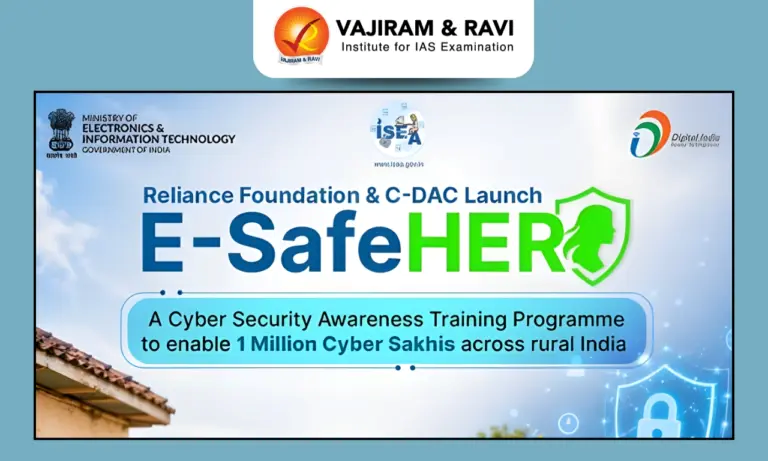
Recently, C-DAC Hyderabad, a scientific society under the Ministry of Electronics and Information Technology (MeitY), Government of India, in collaboration with Reliance Foundation, announced the launch of the e-SafeHER initiative.
- It is a cybersecurity awareness training programme aimed at empowering 1 million women in rural India.
- Its objective is to strengthen last-mile cybersecurity awareness, particularly among women who are increasingly using digital platforms for financial transactions, livelihoods, and essential services.
- The initiative is being implemented by C-DAC Hyderabad under MeitY’s Information Security Education and Awareness (ISEA) programme.
Targets and Duration
- To empower 1 million “Cyber Sakhis” in rural India over the next three years.
Implementation Strategy
C-DAC:
- Will develop, localize, and continuously improve cybersecurity training content under the ISEA project.
Reliance Foundation:
- Through its extensive grassroots network and women empowerment platforms,
- Will deliver training using a community-based and peer-led model.
- The initiative will begin in Madhya Pradesh and Odisha, and will later be expanded across the country in a phased manner.
Key Facts about Information Security Education and Awareness (ISEA)
- It is an initiative of the Ministry of Electronics and Information Technology (MeitY).
- Launched in 2005, it is currently in its third phase starting from October 2023.
Purpose:
- To develop human resources in the field of information security.
- To increase awareness about cyber hygiene and cybersecurity among the general public.
Aim:
- To build human resources for a safe, secure, and trusted cyberspace.
Conclusion
The e-SafeHER initiative is a significant step towards making rural women digitally secure in the modern era. It will not only promote cybersecurity awareness but also strengthen women’s digital empowerment.
Topic Related Videos ⬇️
