Death Penalty, Intermediate Sentencing, and the Shriharan Doctrine in India

Death Penalty, Intermediate Sentencing, and the Shriharan Doctrine in India
The recent decision by a trial court in the Sattankulam custodial death case has reignited the debate over the limits of sentencing under the Shriharan judgment.
Death Penalty
The Supreme Court, in Bachan Singh v. State of Punjab (1980), established the principle that the death penalty should be awarded only in the “rarest of rare” cases.
This doctrine ensures that capital punishment is used sparingly and only when life imprisonment is deemed inadequate.
- Under Article 21, the death penalty is constitutionally valid.
- It is imposed only in exceptionally brutal and extreme cases.
- Courts must consider mitigating factors such as the accused’s background, mental condition, and circumstances.
- Over time, the judiciary has attempted to balance deterrence with human rights concerns.
Intermediate Sentencing
To bridge the gap between life imprisonment and the death penalty, the judiciary evolved the concept of intermediate punishment.
- In Swamy Shraddananda v. State of Karnataka (2008), the Supreme Court introduced the idea of life imprisonment for a fixed term without remission.
- Later, in Union of India v. V. Shriharan (2015), a Constitution Bench ruled that:
- Only High Courts and the Supreme Court can impose such “special category” sentences.
- Trial courts (Sessions Courts) cannot award sentences beyond statutory remission limits.
This created a structural limitation in sentencing powers at the trial level.
Sattankulam Case and the “Shriharan Gap”
The recent lower court judgment (April 6, 2026) in the 2020 Sattankulam custodial deaths highlighted what is often called the “Shriharan gap.”
In this case, a Madurai trial court sentenced nine policemen to death, calling the brutal killing of trader P. Jayaraj and his son Bennix a “rarest of rare” crime. The decision exposes the rigid choices available before a Sessions Court.
1. Meaning of the “Shriharan Gap”
- As per the 3:2 majority in Shriharan (2015), only higher courts can impose fixed-term life sentences (e.g., 20, 30, or 40 years without remission).
- A trial court has only two options:
- Life imprisonment (which may effectively mean release after ~14 years due to remission), or
- Death penalty
- The “gap” refers to the space between these two extremes, where trial courts cannot impose long-term, non-remittable sentences.
2. Sattankulam Judgment and Shriharan
- No middle path: The trial judge acknowledged being bound by Shriharan. While ordinary life imprisonment seemed inadequate, he could not impose a 30-year no-remission sentence.
- Compelled toward death penalty: Since the intermediate option was unavailable, the court applied the “rarest of rare” doctrine and awarded death sentences.
- Reaffirmation of limits: The judge cited recent rulings (including 2025 judgments) confirming that Sessions Courts cannot bridge this gap.
3. Implications of the Judgment
- High Court review: The case will now go to the Madras High Court, which can impose an intermediate sentence under Shriharan.
- Legal paradox: If the High Court commutes the death penalty to a 25–30 year non-remittable sentence, it highlights a contradiction—trial courts cannot award what may be the most appropriate punishment.
Conclusion
The Sattankulam verdict strengthens the ongoing debate on whether the power to impose “special category” sentences—developed in Swamy Shraddananda (2008) and affirmed in Shriharan (2015)—should be extended to trial courts.
Without such reform, Sessions Courts remain trapped between two extremes: “death penalty or 14-year life imprisonment,” with no meaningful middle ground.
Topic Related Videos ⬇️

agarmala Programme
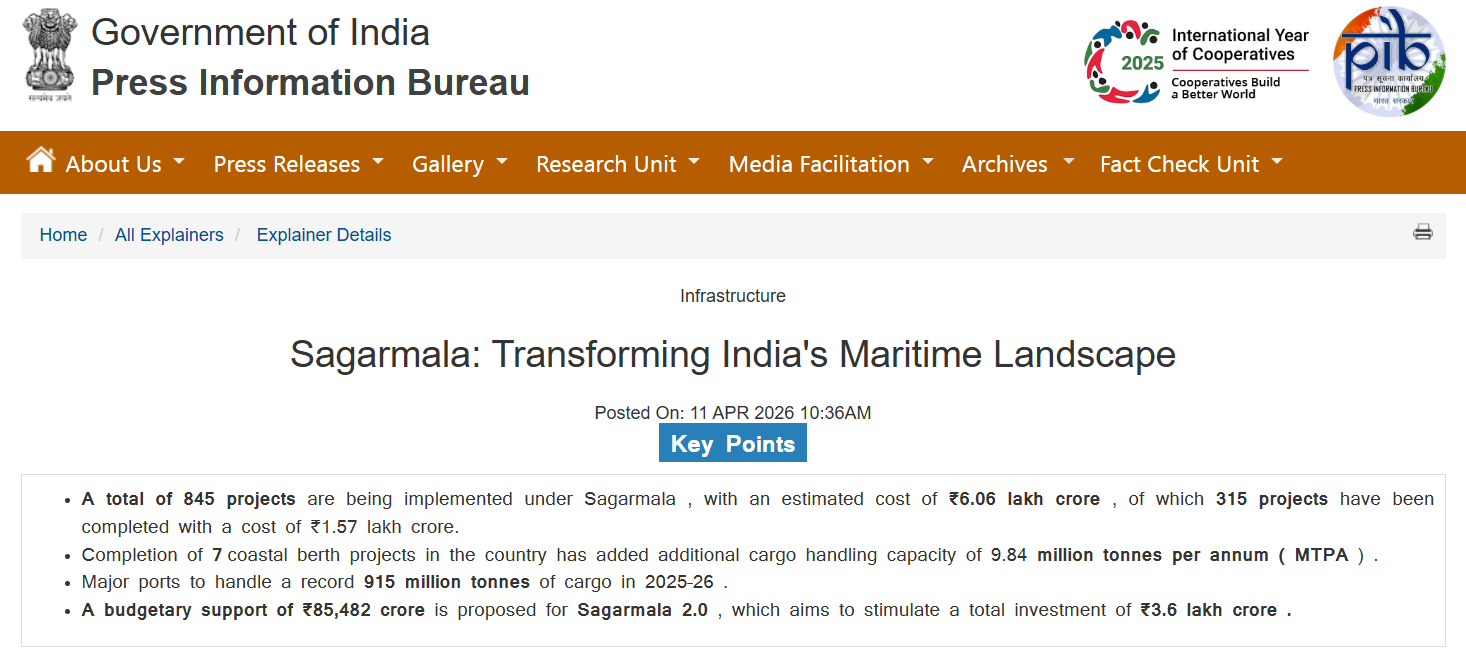
Under the Sagarmala Programme, 845 projects worth ₹6.06 lakh crore are being implemented, out of which 315 projects worth ₹1.57 lakh crore have already been completed.
- It was launched in March 2015 to promote port-led development.
- Its objective is to enhance logistics efficiency, reduce transportation costs, and support trade.
- It promotes the use of coastal shipping and inland waterways, along with integration with road and rail networks.
- The projects under this programme are divided into 5 pillars and 24 categories.
Components of the Sagarmala Programme
1. Port Modernization and New Port Development
- Upgradation of existing ports and development of new ports
- Expansion of capacity and improvement in operational efficiency
2. Port Connectivity Enhancement
- Better connectivity between ports and their hinterlands
- Faster and more cost-effective cargo movement
3. Port-led Industrialization
- Development of industrial clusters around ports
- Promotion of manufacturing and economic activities
4. Coastal Community Development
- Improvement of livelihoods in coastal areas
- Promotion of sustainable development
5. Coastal Shipping and Inland Water Transport
- Greater use of coastal and inland waterways for cargo transportation
Institutional Framework of Sagarmala
The programme is supported by a multi-tier institutional framework to ensure coordinated planning, effective implementation, and continuous monitoring between the Centre and States.
1. National Sagarmala Apex Committee (NSAC)
- Formed in May 2015
- Provides policy guidance and oversight for the programme
2. Maritime State Development Council (MSDC)
- Meets periodically
- Ensures coordination between the Centre and States
- Brings all stakeholders together to promote port development
3. State Sagarmala Committees (SSCs)
- Established in coastal states and Union Territories
- Responsible for identification, implementation, and monitoring of projects
4. Sagarmala Finance Corporation Limited (SMFCL)
- Initially established as Sagarmala Development Company Limited (SDCL) in August 2016
- Reorganized into SMFCL in June 2025
- Plays a crucial role in financing maritime infrastructure development in India
Conclusion
The Sagarmala Programme is a significant initiative aimed at strengthening India’s maritime economy and making logistics more efficient, thereby enhancing overall economic growth and trade competitiveness.
Topic Related Videos ⬇️