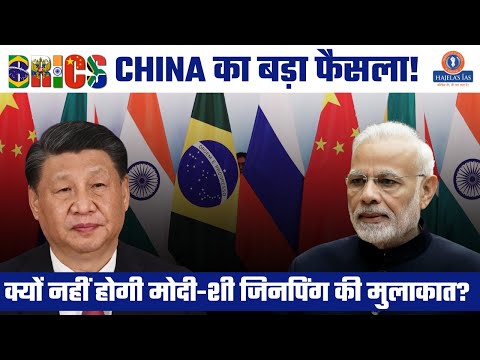
No Modi-Xi Meeting at BRICS Summit: China

Chinese Premier Li Qiang will represent China at the 17th BRICS Summit being held in Brazil later this week. This marks the first time that President Xi Jinping will not attend the annual summit since assuming power in 2012. On Wednesday, Chinese Foreign Ministry spokesperson Mao Ning confirmed that Premier Li would attend the summit in Rio de Janeiro from July 5 to 8 on behalf of Xi. However, she declined to elaborate on why Xi chose not to attend the summit, which he has participated in consistently for over a decade.
PM Modi will also attend this high-profile summit, which comes at a time when India-China relations have seen a thaw following years of tension due to the military standoff in Eastern Ladakh.
Xi's Absence Raises Speculation
Xi’s absence has sparked concern in diplomatic circles, particularly given the recent efforts to reset India-China relations. The 2023 BRICS Summit in Kazan, Russia, was considered a turning point when PM Modi and Xi held their first face-to-face meeting in four years. That meeting paved the way for reopening bilateral communication mechanisms and further diplomatic exchanges aimed at stabilizing ties.
Observers are now questioning whether Xi’s decision to skip the Rio summit signals a diplomatic disengagement with BRICS or points to a broader strategic recalibration, especially as BRICS expands to include Egypt, Ethiopia, Iran, Saudi Arabia, and the UAE.
Modi-Xi: Next Possible Meeting at SCO?
With Xi Jinping stepping away from the BRICS equation this year, attention has shifted to the upcoming Shanghai Cooperation Organisation (SCO) Summit, which China will host in 2025. If PM Modi chooses to attend, it could present the next opportunity for a bilateral meeting between the two leaders.
Topic Related Videos ⬇️
Shanghai Cooperation Organisation (SCO) – India’s Strategic Position and Its Relevance in the Contemporary Global Context

The Shanghai Cooperation Organisation (SCO) is a major multilateral organization that originated in 1996 as the “Shanghai Five”, comprising China, Russia, Kazakhstan, Kyrgyzstan, and Tajikistan. Officially established in 2001, the SCO now represents over 80% of the Eurasian landmass and more than 40% of the global population.
Currently, the SCO has ten full member countries:
India, China, Russia, Pakistan, Kazakhstan, Kyrgyzstan, Tajikistan, Uzbekistan, Iran, and Belarus.
Structure and Objectives
The SCO operates on a consensus-based decision-making system. Its core objectives include:
- Combating terrorism, extremism, and separatism
- Promoting economic cooperation and regional stability
- Strengthening cultural and people-to-people exchanges
Key Institutions of SCO:
- Secretariat – Beijing, China
- RATS (Regional Anti-Terrorist Structure) – Tashkent, Uzbekistan
India’s Strategic Posture and the 2025 SCO Defence Ministers' Meeting
At the 2025 SCO Defence Ministers’ Meeting, India refused to sign the joint communiqué, as it did not mention the terrorist attack in Pahalgam (Jammu & Kashmir), while referencing an incident in Pakistan.
👉 This decision reflects India’s “zero tolerance” policy on terrorism and is a clear assertion of India’s strategic autonomy.
👉 India reaffirmed that peace and terrorism cannot coexist.
👉 China, the current SCO chair and a strategic ally of Pakistan, appeared uncomfortable with India’s stance.
India’s SCO Policy and Strategic Autonomy
India’s approach towards the SCO is guided by the following key principles:
- Strategic Autonomy: India makes foreign policy decisions based on its national interests without aligning to rigid alliances.
- Diverse Engagements: India maintains balanced participation across multiple forums like QUAD, BRICS, G20, and SCO.
- Issue-Based Engagement: India actively engages in areas of direct interest, such as energy security and access to Central Asia.
India vs China: Power Balance within SCO
- China is gradually increasing its dominance in SCO, particularly by promoting the Belt and Road Initiative (BRI).
- India refused to endorse the BRI paragraph during the 2023 SCO Summit, underscoring its resistance to using SCO for unilateral foreign policy goals.
- This reflects India’s stand that the SCO should not become an instrument of any single power.
Limitations of Anti-Terror Cooperation within SCO
India’s experience in SCO provides important lessons:
- Uniform Definitions Matter: Without a common definition of terrorism, unified strategies remain difficult.
- Consensus as a Barrier: While consensus ensures inclusivity, it often leads to decision-making deadlock.
- Bilateral Tensions Impacting Multilateralism: The India-Pakistan conflict and China-Pakistan strategic alliance have repeatedly hindered SCO’s unity and efficiency.
The Road Ahead: India’s Selective Participation in SCO
In the future, India may adopt a selective engagement strategy within the SCO:
- It may actively participate in areas offering real gains in energy, connectivity, and security.
- It will oppose any initiative that undermines India’s sovereignty or core interests.
UPSC Perspective: Key Takeaways
The SCO Summit 2025 marks a significant moment in India’s foreign policy. It demonstrates how India now operates with ideological clarity and strategic firmness even within multilateral platforms.
Important Themes for UPSC Preparation:
- What is strategic autonomy in Indian foreign policy?
- India’s stance within multilateral groupings
- China’s growing influence in SCO and India’s response
- India’s role in anti-terrorism cooperation within SCO
- Pros and cons of consensus-based decision-making
🧠 Practice Question for Mains (GS Paper II):
Q. Analyze the role of India's strategic autonomy and multilateral diplomacy in the context of the Shanghai Cooperation Organisation (SCO).
Answer Guidelines:
- Overview of SCO’s structure and objectives
- India’s historical participation
- India’s stand at the 2025 summit
- China-Pakistan dynamics
- Strategic autonomy and its relevance
- India’s long-term approach to multilateral platforms