Operation Sindhu: What Is It? Why Did India Launch It?

Operation Sindhu was launched by the Government of India to evacuate Indian nationals stranded in Iran amid the escalating Iran-Israel conflict. Under this operation, 110 Indian students were safely evacuated via Armenia and brought to Delhi on a special flight. The Indian government has reiterated that the safety of Indian citizens in crisis-hit regions is a top priority.
Key Details:
- 110 Indian students, studying at Urmia University in Iran, were successfully evacuated under Operation Sindhu.
- Out of these, 90 students were from Jammu and Kashmir.
- Due to the deteriorating security situation, these students were moved by road from Iran to Armenia on 17 June.
- They boarded a special flight from Yerevan, the capital of Armenia, at 2:55 PM (local time) on 18 June, and the flight is scheduled to reach Delhi on the morning of 19 June.
Top Priority: Safety of Indian Citizens
The Government of India has clearly stated that it gives utmost importance to the safety of Indian nationals living abroad.
Given the worsening situation in Iran, India devised a strategy to relocate citizens to safer areas and evacuate them at appropriate opportunities.
India has expressed gratitude to the governments of Iran and Armenia for their cooperation in the evacuation mission.
India Surpasses Pakistan in Number of Nuclear Warheads for the First Time, Deploys New Generation Agni Missiles with MIRV Technology — SIPRI Report

As of January 2025, according to the Stockholm International Peace Research Institute (SIPRI), India possesses approximately 180 nuclear warheads, up from 172 in 2024. In contrast, Pakistan has 170 nuclear warheads, a figure that has remained steady.
Shift in Strategic Balance Between India and Pakistan
According to SIPRI's annual report, this is the first time India has surpassed Pakistan in the number of nuclear warheads. This marks a significant shift in the strategic balance of South Asia.
India’s advancement reflects its investment in next-generation delivery systems and strategic deterrence capabilities.
New Generation Missiles: ‘Canisterised’ and MIRV Technology
SIPRI's report also highlights India’s development of canisterised missile systems:
- These missiles can be stored with warheads during peacetime, allowing for quick deployment and enhanced operational readiness.
- India's Agni Prime (Agni-P) and MIRV-capable Agni-5 are equipped with Multiple Independently Targetable Re-entry Vehicle (MIRV) technology.
- In the future, these missiles could be capable of carrying multiple warheads on a single missile — a capability until now limited to advanced nuclear powers like the USA, Russia, and China.
Agni Prime (Agni-P): A New Medium-Range Missile
- Developed by DRDO, Agni-P is a medium-range ballistic missile (MRBM).
- It can strike targets within a range of 1,000–2,000 km.
- It features a canister-based launch system, which allows quick firing and provides greater security.
Agni-5: India’s Strategic Power
- Has a range of over 5,000 km.
- Can reach all of China, parts of Europe, and even northern Africa, enhancing India’s long-range strike capabilities.
- Equipped with MIRV technology, allowing a single missile to hit multiple independent targets.
- Designed to confuse and penetrate enemy missile defense systems, enhancing survivability and retaliatory effectiveness.
Significance of MIRV Technology:
- MIRV allows a single missile to release multiple warheads, each targeting different locations.
- This makes it harder for enemy defense systems to intercept all incoming threats.
- It strengthens India’s second-strike capability and strategic self-reliance.
- Recent tests suggest India is in the advanced stages of integrating MIRV capability.
India’s Nuclear Doctrine:
- Based on the principle of “Credible Minimum Deterrence”.
- India aims to avoid a nuclear arms race, focusing instead on:
- Survivability
- Second-strike capability
- Strategic autonomy
Regional Context:
- These developments come amid China’s rising missile deployments along the LAC (Line of Actual Control) and Pakistan’s ongoing upgrades to its arsenal, including the Ababeel MIRV missile and Nasr battlefield nukes.
- Missiles like Agni-P and Agni-5 provide India’s Strategic Forces Command (SFC) with greater flexibility, reinforcing regional deterrence against Pakistan and strategic deterrence against China.
China’s Expanding Nuclear Arsenal:
- China’s warhead count rose from 500 in 2024 to 600 in 2025.
- Since 2023, China has been adding 100 new warheads annually.
- China has built 350 new ICBM silos across desert and mountainous regions.
- SIPRI estimates that by the end of the decade, China could have as many ICBMs as Russia or the USA.
Global Outlook:
- China’s nuclear stockpile could reach 1,500 warheads by 2035, still only one-third of the current U.S.-Russia stockpiles.
- The U.S. and Russia currently hold around 90% of the world’s nuclear weapons.
- The New START Treaty is set to expire in February 2026. Without a successor treaty, both countries might increase their strategic deployments.
Conclusion:
SIPRI’s latest report makes it clear that nuclear deterrence dynamics in Asia are rapidly evolving:
- India is witnessing slow but steady growth,
- Pakistan is maintaining a status quo, and
- China is undergoing aggressive expansion.
These trends are reshaping the strategic balance in South Asia and could lead to a new phase of strategic recalibration in the coming years.
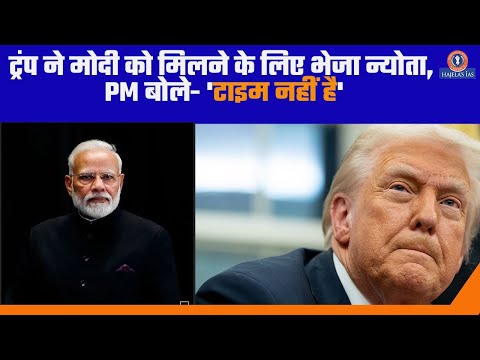
Modi-Trump Talk: Trump Invited Modi for a Visit, PM Replied – ‘No Time’

After the terrorist attack in Pahalgam, Prime Minister Narendra Modi held a 35-minute phone conversation with U.S. President Donald Trump. During the call, Modi clearly stated that there had been no mediation or trade agreement to end hostilities with Pakistan.
President Trump asked PM Modi whether he could visit the U.S. after returning from Canada, but Modi declined the invitation, citing prior commitments.
PM Modi Declines U.S. Visit, Invites Trump to India
After turning down the U.S. visit, Prime Minister Modi invited President Trump to India for their next meeting.
According to Foreign Secretary Vikram Misri, Trump appeared enthusiastic and eager about visiting India.
Misri said,
“President Trump asked whether PM Modi could stop in the U.S. on his way back from Canada. Due to pre-scheduled engagements, the Prime Minister expressed his inability. Both leaders agreed to try meeting in the near future.”
PM Briefs Trump on Operation Sindoor
Misri added that PM Modi gave detailed information about Operation Sindoor during the call.
He made it clear that there had been no discussions on an India–U.S. trade deal being used as a mediation tool between India and Pakistan.
Any de-escalation efforts were conducted directly through established channels between the two countries, and only at Pakistan’s request.
‘India Rejects Any Mediation’
Misri further clarified that India has never accepted, does not accept, and will never accept any external mediation on issues with Pakistan.
He said that there is a strong political consensus in India on this stance.
This clarification came after President Trump had repeatedly claimed that trade was being used as a tool to help end India–Pakistan tensions.
Misri also noted that President Trump listened attentively to PM Modi’s points and expressed his support for India’s fight against terrorism.
Nuclear Power: China Built 100 Nuclear Bombs in a Year — How Many Did India and Pakistan Build?
Modi’s Firm Stand
PM Modi reiterated his "bullet for bullet, shell for shell" policy during the conversation.
Vikram Misri said:
“On the night of May 9, U.S. Vice President Vance called Prime Minister Modi. Vance warned that Pakistan might carry out a major attack on India. PM Modi clearly stated that if that happens, India would respond even more forcefully.”
India indeed responded strongly on the night of May 9–10, inflicting heavy damage on Pakistani forces, and disabling several of its military airbases.
‘Operation Sindoor’ Still Ongoing
PM Modi told President Trump that India no longer sees terrorism as a proxy war, and that Operation Sindoor is still underway.
Topic Related Videos ⬇️