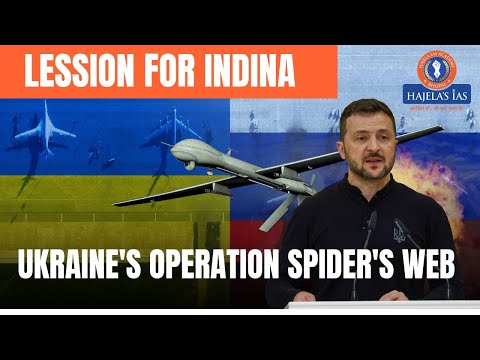
Operation 'Spider Web'

Operation 'Spider Web' is a covert military strike by Ukraine, under which drones were sent as far as 4,000 kilometers inside Russia.
It is considered the longest-range and most technologically advanced attack conducted so far.
Target and Execution
Through this operation, Ukraine targeted Russian air bases that host nuclear-capable bomber aircraft.
The operation was carried out by Ukraine's Security Service (SBU).
A total of 117 drones, equipped with high-end technology, were used in the attack.
These were all FPV (First-Person View) drones, remotely operated by Ukrainian operators from within Russian territory.
Ukraine Shocked Russia
Despite being militarily weaker overall, Ukraine executed the attack effectively, showing that it can still surprise Russia.
While the attack did not impact the operational capabilities of the Russian military, it affected morale and dented the reputation of Russia’s armed forces.
This war, expected to last several more weeks, has now entered its third year.
U.S. Stance
The U.S. position remains unclear.
Zelensky’s recent meeting with Trump was described as awkward, with a focus seemingly on a mineral trade deal.
The U.S. may not continue providing free military aid to Ukraine indefinitely.
European Union's Position
The European Union is also facing a serious economic crisis, which may lead to a reduction in support for Ukraine.
Ukraine might struggle to purchase new weapons.
Comparison with India’s Strategy – ‘Operation Sindoor’
Recently, India’s military encounters with Pakistan were termed ‘Operation Sindoor’, targeting nine terrorist launchpads and key airbases.
This event highlighted the evolving nature of warfare in the region.
In this context, Ukraine’s drone-based strategy offers several lessons.
Operation Spider Web: Five Lessons for India
This operation is a case study in modern warfare, showing how innovation and strategic planning can compensate for conventional military disadvantages.
The operation took over 18 months of planning.
117 drones were smuggled into Russia and hidden in wooden sheds on trucks parked near airbases.
Once activated, they executed coordinated attacks, inflicting an estimated $7 billion in damage to Russia.
Lessons for India:
- Adopt Asymmetric Warfare Strategies
Ukraine’s use of cost-effective drones to inflict serious damage on a superior military force highlights the power of asymmetric warfare.
India could use similar strategies to balance conventional disadvantages.
- Invest in Indigenous Drone Technology
The success of Operation Spider Web underlines the need to develop domestic drone capabilities.
India’s ‘Make in India’ initiative can focus on building advanced drones tailored to national defense needs.
- Strengthen Anti-Drone Systems
The operation exposed weaknesses in traditional air defense systems against drone swarms.
India must prioritize the development and deployment of anti-drone technologies to protect critical infrastructure.
- Enhance Intelligence and Surveillance
Ukraine’s careful planning and execution highlight the importance of superior intelligence.
India must strengthen its intelligence capabilities to detect and neutralize emerging threats.
- Balance Confidentiality with International Cooperation
Ukraine conducted the operation without prior disclosure to its allies, emphasizing operational security.
However, India should strive to balance confidentiality with strategic international cooperation to enhance its defense capabilities.
Topic Related Videos ⬇️