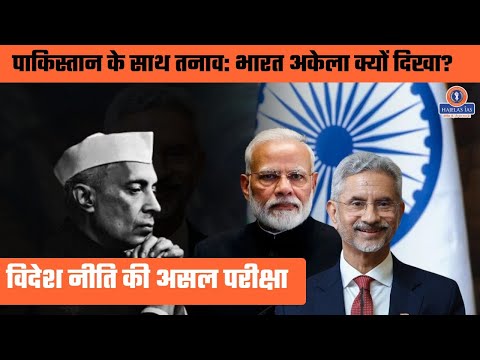
What Happened in the Conflict with Pakistan That Is Raising Questions About India’s Foreign Policy?

During the four-day-long conflict between India and Pakistan, it was interesting to observe how powerful countries around the world reacted.
China openly stated that it is committed to protecting Pakistan’s sovereignty. Turkey also stood with Pakistan.
On the other hand, no country gave a statement in support of India’s sovereignty similar to what China said for Pakistan.
Israel did say that India has the right to self-defense. But compared to Israel, China is a much bigger power and the world’s second-largest economy.
India may argue that it doesn’t depend on anyone to protect its sovereignty.
However, the success of foreign policy or diplomacy is often judged by how many countries stand by your side in a time of crisis.
Questions over India’s foreign policy intensified further when a third country, the United States, announced the ceasefire—and that too in a directive tone.
This implied that the U.S. already knew about the ceasefire in advance and informed the Indian public—not the Indian government itself.
Moreover, Trump did not even mention terrorism in his social media post. He equated India and Pakistan on the same scale.
India does not accept any third-party mediation in the Kashmir issue, but the U.S. explicitly said it brokered the ceasefire—and Pakistan acknowledged this.
India, however, called it a bilateral matter and did not even mention the U.S. in its official response.
Were India and Pakistan Viewed Through the Same Lens?
India does not want to be compared or equated with Pakistan. But throughout this episode, that’s exactly what happened.
Saudi Arabia’s Minister of State for Foreign Affairs visited India first and then went to Pakistan. Iran’s Foreign Minister did the same—visiting Pakistan first, then India.
The United States also treated India and Pakistan in a similar manner.
Many experts say that India has not been very successful in its attempt to "de-hyphenate" itself from Pakistan.
This raises the question: Was the Modi government’s diplomacy successful during the recent standoff with Pakistan?
All global leaders who talked to both India and Pakistan focused on de-escalation, not terrorism.
India wanted to avoid being seen on equal footing with Pakistan—but that did not happen.
India has $140 billion in trade with the U.S., compared to Pakistan’s $10 billion, and still, Trump placed both countries on the same level.
While Pakistan aims to internationalize the Kashmir issue, India is determined to prevent that. Yet this time, Pakistan managed to bring the Kashmir issue to international attention.
Pakistan has always advocated for third-party mediation or UN involvement in Kashmir.
From Non-Alignment to Multi-Alignment in Indian Foreign Policy
India’s first Prime Minister Jawaharlal Nehru chose the path of Non-Alignment for foreign policy—a path followed by his successors.
However, Prime Minister Narendra Modi and External Affairs Minister S. Jaishankar have steered the policy toward Multi-Alignment.
Nehru’s approach was to avoid joining any bloc; Modi’s strategy is to engage with all blocs.
The term Multi-Alignment was first used in 2012 by Shashi Tharoor, then Minister of State for Human Resource Development.
Tharoor had said:
“Non-Alignment has lost its relevance. The 21st century is the age of Multi-Alignment. No country, including India, can progress without cooperation from others. We live in a world where isolation is not an option. India too has become more global.”
In 2016, Modi became the first Indian Prime Minister since 1979 to skip the Non-Aligned Movement (NAM) summit, signaling a shift from Nehru’s legacy.
Under Modi, ties with the United States have deepened. Modi even called the U.S. a “natural partner,” which goes against the Non-Alignment principle.
India’s Growing Closeness to the U.S. Is Opportunistic, Lacks the Trust Once Shared with the USSR
In 2019, Foreign Secretary Vijay Gokhale said that India and the U.S. are partners, but their cooperation is issue-based, not ideological.
Many analysts believe the U.S. sympathizes with India to counter the growing challenge posed by China.
As part of this Multi-Alignment, India is a member of both the Quad and the SCO.
The SCO (Shanghai Cooperation Organisation) is dominated by China and Russia, while the Quad is perceived as an anti-China group.
Russia was unhappy with India joining the Quad. In December 2020, Russian Foreign Minister Sergey Lavrov said:
“The West wants to restore a unipolar world, but Russia and China are unlikely to be subservient.
India is now a pawn in the West’s anti-China policy in the Indo-Pacific through the so-called Quad.”
Questions on the Role of the Quad
Pakistan and India are both members of the SCO. Interestingly, China, an SCO member, openly supported Pakistan, while Russia did not show the same support for India.
At the same time, none of the Quad countries made any strong statement in India’s favor. The Quad consists of the U.S., Japan, Australia, and India.
Russian political theorist Alexander Dugin posted on X (formerly Twitter):
“In the real crisis, Quad offered no help to India. The U.S. only advised a halt in conflict. Is that the role of an ally?”
A counter-argument is that the Quad is not a military alliance. India is not a client state of any superpower. India’s policy is strategic autonomy.
Whether it’s someone else’s war or India’s own, India does not compromise its independence.
International Politics Is Full of Contradictions
“India and Pakistan are rivals.
India and China are competitors.
India and Russia are strategic partners.
Russia is nearly allied with China.
Pakistan is in China’s pocket—once an ally of the U.S.
Pakistan is now closely aligned with Turkey.”
Turkey is a NATO member and hence a security partner of the U.S.
The U.S. has strategic, economic, and defense ties with India—yet it once eliminated the man responsible for the New York attack on Pakistani soil, souring ties.
Despite this, the U.S. still places India and Pakistan on the same level.
Pakistan receives military aid from China—America’s top rival—and from Turkey, a NATO partner.
This is the contradiction of modern geopolitics.
Quad Might Also Pay the Price for India-Pakistan Tensions
Sadanand Dhume, fellow at the American Enterprise Institute, believes the India-Pakistan conflict may affect the Quad.
He wrote on X:
“I wouldn’t be surprised if the recent tensions take a toll on the Quad.
China openly backed Pakistan without hesitation. Pakistan is clearly a client state.
But can anyone say the Quad members supported India with the same clarity?”
He added:
“I’m not saying the Quad will collapse, but skepticism will grow in India.
The U.S., Japan, and Australia missed the chance to show they’re reliable allies.
Quad supporters must acknowledge this failure.”
India has also taken a different stance on Russia than the other Quad nations.
When Russia invaded Ukraine in February 2022, all Quad members except India supported Ukraine and even joined Western sanctions.
India refrained from voting on every anti-Russia resolution at the UN.
Changing World Order
India is part of China-dominated blocs like BRICS and SCO, as well as China-opposing groups like the Quad.
When Trump returned to power, he reversed U.S. policy on Ukraine and seemed to support Russia—leading many to say India was right not to bow to Western pressure.
Prof. Mohammad Mudassir Qamar, former associate fellow at Manohar Parrikar Institute for Defence Studies and Analyses, argues that India’s foreign policy has not failed during the recent conflict.
“India is not a client state.
China supports Pakistan because Pakistan is a client state with no autonomy.
India, the world’s fourth-largest economy, cannot be pushed around.”
He adds:
“India’s multi-alignment policy means it works with everyone based on national interests and has the courage to speak out where its interests are harmed.
Every policy has its own strengths and needs periodic review.
We can’t judge foreign policy or alliances based on one event.
India’s cooperation in the Quad or SCO is also issue-based.”
The old world order is being challenged—by Russia’s invasion of Ukraine, Israel’s actions in Gaza, rising distrust of the U.S., and China’s rise.
India too faces the challenge of finding its place in the new world order.
While the U.S., EU, China, and Russia try to shape the global order, the positions of countries like Turkey, Saudi Arabia, India, Indonesia, and African nations will be crucial.
Even as a NATO member, Turkey did not join Western sanctions against Russia.
Canada, a NATO co-founder, suggested merging NATO with the U.S.—despite NATO being a military alliance.
Thus, the world order is full of contradictions—and India’s foreign policy cannot remain untouched by them.
- 10 Objective Questions (MCQs)
- 2 Mains Questions with Model Answers
- 1 Essay (1000–1200 words)
✅ 10 Objective Questions (MCQs) for UPSC – In English
1. List-Type Question
Match the countries with their roles in the India-Pakistan conflict:
|
Country
|
Role
|
|
A. China
|
1. Supported Pakistan's sovereignty
|
|
B. Israel
|
2. Supported India’s right to self-defence
|
|
C. USA
|
3. Called for a ceasefire
|
Choose the correct option:
A. A-2, B-3, C-1
B. A-1, B-2, C-3 ✅
C. A-3, B-1, C-2
D. A-2, B-1, C-3
2. Simple Question
Which Indian policy is referred to as "Multi-alignment"?
A. Non-alignment
B. Joining a single military bloc
C. Maintaining relations with all major powers ✅
D. Relying on the United Nations
3. Matching-Type
Match India’s participation with organizations:
|
Organization
|
India’s Role
|
|
A. QUAD
|
1. Strategic group opposing China
|
|
B. SCO
|
2. China-Russia-influenced platform
|
|
C. BRICS
|
3. Group of emerging economies
|
Choose the correct match:
A. A-1, B-2, C-3 ✅
B. A-2, B-3, C-1
C. A-3, B-1, C-2
D. A-1, B-3, C-2
4. Assertion-Reason Type
Assertion (A): The US asked both India and Pakistan to observe a ceasefire.
Reason (R): The US sees India and Pakistan on equal footing.
A. Both A and R are true, and R is the correct explanation of A ✅
B. Both A and R are true, but R is not the correct explanation of A
C. A is true, R is false
D. A is false, R is true
5. Assertion-Reason Type
Assertion (A): India rejects third-party mediation.
Reason (R): India considers Kashmir a bilateral issue.
A. Both A and R are true, and R is the correct explanation of A ✅
B. Both A and R are true, but R is not the correct explanation of A
C. A is true, R is false
D. A is false, R is true
6. Which concept replaced Nehru-era Non-Alignment in India’s foreign policy?
A. Multipolarity
B. Independent Cooperation
C. Multi-alignment ✅
D. Apolitical Policy
7. Which of the following countries is a member of the Quad?
A. Russia
B. China
C. Australia ✅
D. Pakistan
8. In which year did India not attend the Non-Aligned Movement (NAM) summit?
A. 2014
B. 2016 ✅
C. 2018
D. 2020
9. Which of the following statements is incorrect?
A. Both India and Pakistan are members of SCO.
B. Quad is a military alliance. ✅
C. India’s policy is issue-based partnership.
D. Russia has criticized India’s involvement in Quad.
10. Who first used the term "Multi-alignment"?
A. Narendra Modi
B. Shashi Tharoor ✅
C. S. Jaishankar
D. Manmohan Singh
UPSC Mains Questions with Model Answers
Q1: Examine the challenges to India’s foreign policy in light of the recent India-Pakistan conflict.
Answer:
During the recent India-Pakistan conflict, global responses raised critical questions about India’s foreign policy. China supported Pakistan’s sovereignty, while the US treated both sides equally and called for a ceasefire. India maintains that the Kashmir issue is bilateral and rejects third-party mediation, yet the US took an indirect mediator role.
India follows a multi-alignment policy, participating in both Quad and SCO. However, during the crisis, no major ally came forward to strongly support India. This raises concerns about whether India’s strategic autonomy deprives it of reliable support during crises.
Thus, India must reassess its multi-alignment approach and ensure greater coherence and dependable backing on global platforms.
Q2: "India's foreign policy is neither non-aligned nor fully cooperative, but issue-based." Discuss.
Answer:
India’s foreign policy historically stood on the foundation of Non-Alignment, pioneered by Nehru. In recent years, especially under the Modi government, this has evolved into multi-alignment—engaging with all powers based on national interest.
India cooperates with both adversarial powers: with Russia and Iran on energy, with the US in the Indo-Pacific (QUAD), and with Israel on defence. For instance, India remained neutral on the Russia-Ukraine conflict, yet maintained strategic ties with the US.
This approach reflects strategic autonomy, but its limitations are evident during crises, such as during conflicts with Pakistan, when strong international support was lacking.
Thus, while India’s foreign policy is issue-based, it must maintain a delicate balance to ensure consistency and trust from its global partners.
Essay (1000–1200 words)
Title:
"India’s Foreign Policy: Strategic Autonomy or Lack of Global Support?"
Introduction:
India’s foreign policy has traditionally been shaped by the principles of sovereignty, independence, and strategic autonomy. From Nehru’s Non-Alignment Movement (NAM) to the Modi government’s shift towards multi-alignment, India has tried to maintain equidistance from major global powers. However, recent developments—especially in the backdrop of India-Pakistan tensions—have raised a critical question: Does India’s autonomy come at the cost of international support?
Main Body:
1. Recent Conflict and Global Response:
- China and Turkey openly supported Pakistan.
- The US called for a ceasefire but avoided mentioning cross-border terrorism.
- Quad members like Japan and Australia remained silent.
This response highlights a lack of strong global backing during a strategic crisis for India.
2. Evolution of India’s Foreign Policy:
- Nehru Era: Emphasis on Non-Alignment during the Cold War era.
- Post-Cold War Shift: Increased engagement with the US, Russia, and EU.
- Modi Era: Strategic engagements through Quad, SCO, and BRICS, reflecting multi-alignment.
India seeks to engage all major powers to extract maximum benefits while avoiding entanglement in permanent alliances.
3. Strategic Autonomy vs Support Deficit:
- India avoids becoming a client state of any power.
- However, in moments of conflict (like surgical strikes or Balakot), global reactions have been neutral or passive.
- Even close partners hesitate to take a firm stand.
This raises concerns over the credibility of India’s strategic partnerships.
4. Internal Contradictions:
- India has strong ties with Russia, which also aligns closely with China and Pakistan.
- It partners with the US in the Indo-Pacific, but the US continues arms support and aid to Pakistan.
- This duality creates challenges in gaining unwavering support.
5. The Way Forward:
- Strategic autonomy should not mean isolation.
- India must build issue-based alliances that translate into reliable diplomatic support during crises.
- Forums like G20, SCO, BRICS, and Quad must be leveraged proactively.
- Bilateral diplomacy must emphasize shared values and strategic convergence, especially in security and counter-terrorism.
Conclusion:
India’s foreign policy today is a delicate exercise in balancing autonomy with global engagement. While it rightly avoids rigid blocs, the absence of strong support during crises is a signal to strengthen diplomatic trust and clarity. As India aspires for global leadership, it must evolve a foreign policy that ensures independent decision-making as well as collective strategic backing.
Topic Related Videos ⬇️