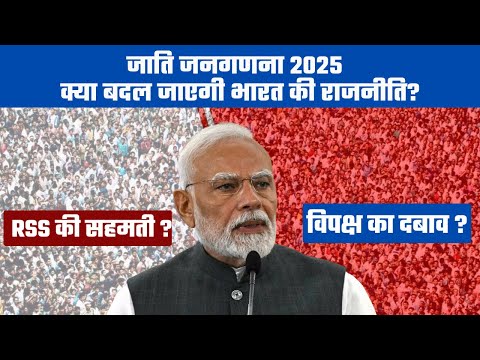
Caste Census

2 May 2025
Union Minister Ashwini Vaishnaw, while informing about the government's decision taken in the Cabinet Committee on Political Affairs meeting, stated that caste enumeration will now be conducted along with the national census.
Vaishnaw said that census is a Union subject, and the caste surveys conducted in some states so far have not been transparent.
The key question being raised is — why has the Modi government, which had previously avoided caste-based census, now agreed to it?
Several opposition parties, including the Congress, Samajwadi Party, and Rashtriya Janata Dal, have consistently demanded a caste census in the country.
Congress leader Rahul Gandhi, raising the issue of caste census, said:
"Everyone should know how many Dalits, backward classes, tribals, minorities, and poor members of the general category live in this country. Only then can we understand their actual share in the nation’s resources."
In political circles, the question being asked is:
What compelled the Modi government, which once refused caste census, to now agree to include caste enumeration in the national census?
"When the Modi government refused the caste census, the opposition's Grand Alliance (Mahagathbandhan) made it a major national issue."
"Meanwhile, Bihar and Karnataka conducted their own caste surveys, revealing the population proportions of backward and extremely backward castes. This clarified their potential political representation. Due to this growing pressure, the Modi government was compelled to agree to a caste census."
Is the motive to gain electoral advantage in Bihar?
According to the caste survey conducted in Bihar:
- Extremely Backward Classes (EBCs) are 27.12%,
- Other Backward Classes (OBCs) are 36.01%,
- Scheduled Castes (SCs) make up 19.65%,
- Scheduled Tribes (STs) are 1.68%, and
- Unreserved (general category) groups are 15.52% of the population.
The last caste census in India was conducted in 1931.
Since then, caste-wise data has not been collected in national censuses.
The number of Dalits (SCs) and Tribals (STs) is counted in the census, and they also have political reservation.
However, the population of Backward and Extremely Backward Classes (OBCs and EBCs) is not officially counted in modern Indian censuses.
It is believed that 52% of the country’s population belongs to the backward and extremely backward castes. Leaders of the OBC community believe that their political representation is significantly lower than their population share.
Political parties are supporting the caste census to gain the backing of these communities.
It is being said that the BJP accepts votes from these communities but does not want to reveal their actual numbers,
because doing so would expose how underrepresented backward and extremely backward castes are in politics and the bureaucracy.
Is the BJP no longer afraid of this fact being revealed? Or has it taken this step to gain electoral advantage in Bihar, where assembly elections are due at the end of this year?
Could the BJP benefit from conducting a caste census in Bihar’s elections?
It is said that the BJP was previously opposed to this idea. The party had described caste-based census as an attempt to divide the country.
However, most of the BJP’s allies in the NDA are in favor of it.
In Bihar, a caste survey was already conducted in 2023, when the BJP’s ally JD(U) was in government with RJD.
In Karnataka, the Congress government has also conducted a caste survey.
JD(U) and LJP (Ram Vilas faction) have also demanded a caste-based census.
JD(U) had raised the issue in the Parliament’s OBC Welfare Committee.
At that time, the BJP had neither openly opposed nor commented on the caste-based census.
Pressure from allies and the opposition:
The central government noticed that several states have already conducted caste surveys,
so it could also conduct a caste enumeration at the national level.
Interestingly, the Yogi Adityanath government in Uttar Pradesh had previously stated that it would not conduct a caste census.
But now, with the central government agreeing to it, it remains to be seen what Uttar Pradesh will do.
RSS's stance on caste census:
Sunil Ambekar, the All-India Publicity Head of the Rashtriya Swayamsevak Sangh (RSS), once said in a statement that
RSS supports the caste census.
In September 2024, after an internal RSS meeting, it was said that they have no objection to the caste census,
but it should not be used for political gain.
However, it is clear that political parties are likely to try and benefit from it.
"In fact, the shift within the Modi government regarding the caste census occurred after the Rashtriya Swayamsevak Sangh (RSS) expressed its stance on the issue."
"In recent years, the BJP has successfully managed to bring backward and Dalit communities into its fold. Through this caste-based enumeration, the BJP also wants to demonstrate that apart from one or two communities, a significant portion of the OBC population supports it. This would serve as a stamp of approval on its efforts to consolidate the OBC vote base."
Why was there no caste census after Independence?
In India, the practice of conducting censuses began in 1872 during British rule.
Until 1931, the British government included caste-related data in every census.
After independence, when India conducted its first census in 1951,
only individuals from the Scheduled Castes (SCs) and Scheduled Tribes (STs) were classified by caste.
Since then, the Government of India has avoided caste-based enumeration as a policy decision,
and the Supreme Court has also reiterated in various cases that caste-based census cannot be conducted as per the law,
because the Constitution recognizes individuals as citizens based on population, not on caste or religion.
The scenario began to change in the 1980s with the rise of several regional political parties whose politics was based on caste identity.
These parties not only challenged the dominance of so-called upper castes in politics but also started movements
to secure reservation for so-called lower castes in government education institutions and public employment.
In 1979, the Government of India set up the Mandal Commission to examine the issue of reservation for socially and educationally backward classes.
The Mandal Commission recommended reservations for the OBC category,
but it was only in 1990 that these recommendations were implemented.
This led to widespread protests by students from the general category across the country.
Since the issue of caste census became intertwined with reservations, political parties began raising demands for it from time to time.
Eventually, in 2010, when a large number of Members of Parliament demanded a caste-based census,
the then Congress-led government agreed.
In 2011, a Socio-Economic and Caste Census (SECC) was conducted,
but the caste-related data collected during this process was never made public.
Census in India
Census in India is an important and constitutional process that presents the social, economic, and demographic picture of the country. Below is detailed information related to the census in India:
Who conducts the Census in India?
- Conducted by:
The Census in India is conducted by the Registrar General and Census Commissioner of India, which functions under the Ministry of Home Affairs, Government of India.
- Institution:
The operation of the census falls under the Registrar General and Census Commissioner, India (RGI).
- Legal Framework:
This task is carried out under the provisions of the Census Act, 1948.
Why is Census conducted in India?
- Population Count:
To obtain data on the total population of the country.
- Policy Formulation:
Policies related to education, health, employment, housing, etc., are formulated based on census data.
- Development Planning:
To determine the targets of central and state government schemes.
- Socio-economic Profiling:
To assess gender ratio, literacy rate, and the status of tribal and backward communities.
- Administrative Convenience:
Delimitation of parliamentary constituencies and determination of reservation policies.
✅ History of Census in India
|
Year
|
Details
|
|
1872
|
First census conducted (not complete), initiated by Lord Mayo during British rule.
|
|
1881
|
First complete census; start of the regular decennial process.
|
|
1947
|
Census operations continued post-independence.
|
|
1951
|
First census of independent India; included information on refugees.
|
|
1961-2011
|
Regular decennial censuses conducted every ten years — e.g., 1961, 1971, 1981, 1991, 2001, 2011.
|
|
2021
|
The 16th Census was proposed but postponed due to the COVID-19 pandemic.
|
Status till 2024–25:
- The 2021 Census has not yet been conducted.
- This is the first time there has been such a delay in the Indian census.
- There are plans to collect data using digital means in the upcoming census.
✅ Key Features of the Census
- It is the largest administrative exercise in the country.
- Conducted in two phases:
- House listing and housing census
- Population enumeration
- It is a person-based enumeration.
- The data is kept confidential as per the Census Act, 1948.
Reasons for Delay in the 2021 Census
- COVID-19 pandemic
- Lack of preparedness among some states
- Transition towards digital census and the need for training
Caste-Based Census in 2025:
- The demand for a caste-based census in India has existed for years, especially from the Other Backward Classes (OBCs), Scheduled Castes (SCs), Scheduled Tribes (STs), and supporters of social justice.
- The last census in which all castes were enumerated was in 1931, during British rule.
- Since 1951, only the population data of SCs and STs has been officially published.
- In 2025, the Central Government has announced for the first time a caste-based census, aiming for a scientific enumeration of all castes, including OBCs.
🔷 Objectives of the Caste Census
- To collect accurate socio-economic data.
- To obtain the actual population count of OBCs.
- To better target policies and schemes based on caste data.
- To bring transparency in social justice and reservation policies.
- To analyze the status of sub-groups within SC, ST, and OBC categories.
Key Features of Caste Census 2025
|
Element
|
Details
|
|
Start Year
|
2025
|
|
Implementing Agency
|
Registrar General and Census Commissioner of India (RGI)
|
|
Coverage
|
All of India; all castes
|
|
Digital Mode
|
Data collection through mobile apps and digital platforms
|
|
Data Points
|
Caste, income level, education, employment, housing, social status, etc.
|
|
Consent-Based
|
Data will remain confidential and will be shared voluntarily
|
🔷 Caste Census vs. Socio-Economic Caste Census (SECC)
|
Feature
|
SECC 2011
|
Caste Census 2025
|
|
Objective
|
Poverty and socio-economic profiling
|
Actual caste-wise population count
|
|
Data
|
Partial caste data
|
Comprehensive caste data
|
|
Publication
|
OBC data not released
|
All caste data, including OBCs, to be released
|
|
Scope
|
Rural-focused
|
All-India coverage
|
Issues, Arguments, and Significance of the Caste-Based Census 2025:
Issues & Challenges
- Political Controversy:
Caste data can be used for political gain, increasing the risk of social division.
- Technical Complexities:
There are thousands of castes and sub-castes, making classification extremely difficult.
- Privacy Concerns:
Ensuring the confidentiality of personal caste information is a major challenge.
- Data Verification Challenges:
Caste identity is often based on self-declaration, increasing the chances of inaccuracies.
- Constitutional Debate:
Should caste-based data be used in policymaking, or does it go against the principle of equality enshrined in the Constitution?
🔷 Arguments in Favor
- Accurate data can make the reservation policy more rational and evidence-based.
- Helps ensure that schemes reach the actual beneficiaries.
- Like SCs/STs, OBCs should also receive due benefits based on data.
- Since no caste data has been published since 1931, policy formulation remains incomplete.
🔷 Importance – For UPSC Preparation
Prelims:
- 1931 was the last caste-based census.
- Key facts related to SECC 2011.
- Provisions of the Census Act, 1948.
Mains Questions:
- "Discuss the relevance and implications of caste-based census in India in the context of social justice."
- "Caste data is necessary for targeted development. Critically analyse."
Essay Topics:
- "Caste Census: A step towards social justice or a cause of social polarization?"
🔷 Conclusion
Caste Census 2025 represents a historic opportunity for the Indian government to scientifically assess the condition of marginalized communities. However, it is equally important to handle the associated political, administrative, and social dimensions with balance and sensitivity.
Topic Related Videos ⬇️