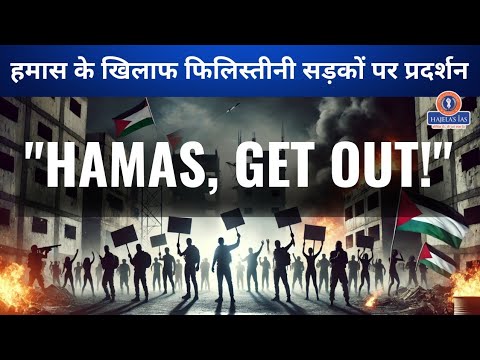
Historic Protests Against Hamas in Gaza: War-Weary Palestinians Take to the Streets, Demand Hamas to Step Down

Children holding posters written in Arabic that read: "We refuse to die."
For the first time, protests against Hamas have erupted in Gaza. On Tuesday, demonstrations took place in three locations, with thousands of people participating. The protesters labeled Hamas as a terrorist organization and demanded that it step down from power.
The people of Gaza are exhausted by the Israel-Hamas war. Protesters on the streets chanted slogans like "Hamas, get out!", "Hamas is a terrorist organization," and "We want to overthrow Hamas." They carried posters with messages such as "End the war" and "Children in Palestine want to live."
Four Reasons Why Gazans Do Not Want War
1. Massive Destruction
- Over 1.75 lakh (175,000) buildings, which is more than 72% of the total structures, have been destroyed in Gaza.
- Homes, schools, hospitals, and markets have turned into rubble.
- People have been left homeless with no safe place to stay.
2. Displacement
- Nearly the entire population of Gaza (over 2 million people) was forced to flee their homes.
- After the ceasefire, many returned, but Israel resumed attacks, preventing them from settling back.
- Now, people do not want to leave Gaza again.
3. Starvation and Lack of Basic Needs
- People are forced to live in makeshift tents or among ruins, with no access to basic facilities like water, electricity, and toilets.
- Due to Israel’s blockade, humanitarian aid (food, medicines, fuel) is not reaching Gaza.
- Shops have shut down, food prices have skyrocketed, and people are facing starvation.
4. Impact on Children and Families
- More than half of the casualties are children and women.
- Many children have become orphans, and due to the trauma of war, some are experiencing speech disorders, such as stammering.
- Families are unable to protect their children, leading to grief and helplessness.
Rising Opposition to Hamas in Gaza
- After the war with Israel, Hamas has faced growing criticism.
- The Palestinian Center for Policy and Survey Research (PCPSR) conducted a survey in Gaza in September 2024:
- 35% supported Hamas
- 26% opposed Hamas
- One year earlier (October 2023), 71% supported Hamas, while only 21% opposed it.
Key Facts About Hamas
- Founded in 1987 (Harakat al-Muqawama al-Islamiyya) to resist Israel and establish a Palestinian state.
- Won Palestinian legislative elections on January 25, 2006.
- Secured 74 out of 132 seats, while rival Fatah won 45 seats.
- In June 2007, a violent conflict between Hamas and Fatah left over 600 dead.
- Since then, Hamas has controlled Gaza, while Fatah controls the West Bank.
Death Toll in Gaza
- As of March 25, 2025, over 50,000 Palestinians have died in the Israel-Hamas war.
- More than 113,000 people have been injured.
- The ceasefire between Israel and Hamas (December 2024 - January 2025) has ended, and attacks have resumed.
- Since the resumption of attacks, 673 people have been killed.
Israel-Palestine Conflict (1948 - 2025)
UPSC/PSC Perspective | Date: March 27, 2025
The Israel-Palestine conflict is one of the most complex geopolitical disputes of the 20th and 21st centuries.
The conflict revolves around land, religious identity, and political control.
It has passed through various phases (1948 - 2025), including wars, peace agreements, and regional instability.
🔹 Historical Background (Before 1948)
1. Ottoman Empire (1517-1917)
- Palestine was part of the Ottoman Empire.
- It was a sacred land for Jews, Christians, and Muslims.
2. British Rule & Balfour Declaration (1917-1948)
- In 1917, the British government issued the Balfour Declaration, supporting the creation of a Jewish national home.
- This led to rising tensions between Jews and Arabs.
- In 1947, the United Nations Partition Plan proposed dividing Palestine into two states, but Arab nations rejected it.
-
Formation of Israel & Early Wars (1948-1967)
1. Creation of Israel & First Arab-Israeli War (1948)
- On May 14, 1948, Israel was declared an independent Jewish state.
- Arab nations (Egypt, Jordan, Syria, Iraq, Lebanon) attacked Israel in the First Arab-Israeli War.
- Result:
- Israel won, and over 700,000 Palestinians were displaced (Nakba - "The Great Catastrophe").
-
2. Second Arab-Israeli War (1956 - Suez Crisis)
- Egypt nationalized the Suez Canal.
- Israel, the UK, and France attacked Egypt.
- Result: Israel withdrew under US and Soviet pressure.
-
3. Six-Day War (1967)
- Israel vs. Egypt, Syria, Jordan
- Result:
- Israel captured Gaza Strip, West Bank, Golan Heights, and Sinai Peninsula.
- Palestinian resentment grew, leading to the rise of PLO (Palestine Liberation Organization).
-
🔹 Major Events (1967-2000)
1. Rise of PLO & Yasser Arafat (1964-1993)
- 1964: PLO was established.
- 1987: The First Intifada (Palestinian uprising) began.
- 1993: The Oslo Accords were signed (first peace agreement between Israel and PLO).
-
2. Second Intifada (2000-2005)
- Triggered by clashes at Al-Aqsa Mosque in Jerusalem.
- Hamas and extremist groups became more active.
-
🔹 21st Century Conflicts (2005-2025)
Gaza Conflict (2005-2021)
- 2005: Israel withdrew from Gaza.
- 2006: Hamas won Palestinian elections and took control of Gaza.
- 2008, 2012, 2014: Major Israel-Gaza conflicts.
- 2021: 11-day war between Israel and Hamas.
-
October 2023 Hamas Attack & Israel-Gaza War (2023-2024)
- Hamas launched rocket attacks on Israel, killing 1,400+ Israelis.
- Israel responded with massive air and ground attacks on Gaza.
- Thousands of Palestinian civilians died.
-
2024-2025 Conflict & Global Impact
- Israel continued military operations in Gaza to weaken Hamas.
- US and Western nations supported Israel, while Iran and Turkey supported Palestine.
- UN and global organizations raised concerns over humanitarian crises.
- 2025: The conflict persisted, affecting Middle Eastern stability.
-
🔹 Key Agreements & Proposals
- UN Partition Plan (1947) – Rejected by Arabs.
- Oslo Accords (1993) – First peace talks between Israel & PLO.
- Camp David Accords (1978) – Peace between Israel & Egypt.
- Abraham Accords (2020) – Normalization of ties between Israel and UAE, Bahrain, Morocco.
-
🔹 India’s Perspective on the Conflict
- Balanced approach – Supports the Two-State Solution.
- Strengthened defense & tech ties with Israel.
- Maintains diplomatic support for Palestine.
-
📝 UPSC Questions
- Discuss the historical causes of the Israel-Palestine conflict.
- Analyze India's policy toward the Israel-Palestine issue.
- Evaluate the feasibility of the Two-State Solution.
Topic Related Videos ⬇️