Why Agriculture in Space?

Image Source: NASA
‘Space Agriculture’ is one of the many research projects being carried out in space. Several studies related to this are underway on the International Space Station (ISS).
Astronauts are already sent with a sufficient amount of pre-processed food.
However, studying distant planets and celestial bodies can take weeks, months, or even several years. In such an environment, growing food in space could prove useful.
According to the American space agency NASA, growing plants in space can become a sustainable food source and an essential technology for long-duration space missions and for establishing human settlements on other planets.
Plants are also grown on space stations to recycle oxygen and water.
Topic Related Videos ⬇️
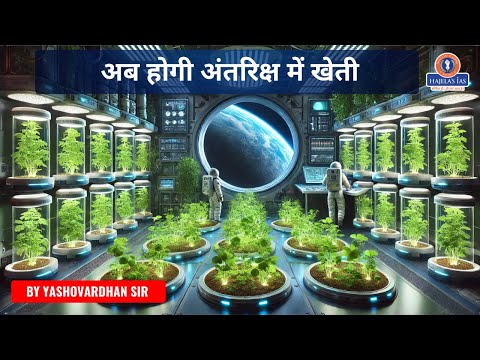
How are Plants Grown?

For growth, plants need sunlight, water, oxygen, and soil. But even more important is gravity. It is because of gravity that roots grow downward.
This helps plants stand firmly in the soil. Water and other nutrients absorbed from below reach other parts of the plant.
How are plants grown in the zero-gravity environment of space?
NASA, in collaboration with Fairchild Botanical Garden (USA), launched a project called ‘Growing Beyond Earth’.
NASA conducted several experiments to create a garden in a zero-gravity environment.
There is a special chamber called ‘Veggie’, designed to provide a suitable environment for growing plants in space.
Just like on Earth, plants are grown from tiny seeds. In this system, soil and nutrients necessary for plant growth are pre-provided, and only water needs to be added.
Using this method, NASA has successfully grown plants like spinach and tomatoes in space.
In the ‘Veggie’ project, there is a sub-project called ‘X-ROOTS’, where plants are grown using hydroponics or aeroponics methods — without soil or other necessary factors.
Topic Related Videos ⬇️
What is Hydroponics and Aeroponics?

In hydroponics, plants are grown without soil, only in water and nutrient solutions.
In aeroponics, plant roots are suspended in the air, and water and nutrients are sprayed on them.
NASA is also growing plants on the space station through another project called the Advanced Plant Habitat.
In this system, all environmental conditions necessary for plant growth are controlled by sensors. It creates an ideal environment for plant growth, including temperature, humidity, light, carbon dioxide, and other environmental factors.
Equipped with features like LED lighting and irrigation systems, this system requires minimal maintenance.
Astronauts do not need to put in much effort or time. Through this system, NASA has successfully grown chili peppers, radishes, and some flowers.
Topic Related Videos ⬇️
India’s Role

Image Source: ISRO
ISRO has grown black-eyed pea (lobia) seeds as part of one of its projects.
The Indian Space Research Organization (ISRO) launched CROPS (Compact Research Module for Orbital Plant Studies) earlier this year via the PSLV-C60 POEM-4 rocket to research plant cultivation in space.
For this experiment, 8 black-eyed pea seeds were placed in a customized environment for germination. By the fourth day, the seeds had started sprouting, and by the fifth day, two leaves emerged from the germinated seeds. This was considered a significant achievement by ISRO.
According to Pandian, the former director of Satish Dhawan Space Centre (ISRO), the European Space Agency (ESA) and other space research organizations are also working to improve techniques for growing plants in space and developing new crop varieties.
Why Do Plants Grow Faster in Space?
There are several reasons for growing crops in space.
Pandian says, "It will provide astronauts with fresh and nutritious food. These plants will also help generate oxygen for astronauts to breathe. Even in small amounts, they are natural and beneficial for their health and nutrition."
He adds that plants can be grown faster in space.
"For example, when farming on Earth, fertilizers applied to plants can be washed away by rain or take longer to be absorbed by plants. But in these projects, essential nutrients are directly supplied to the plants, allowing them to absorb them faster and grow quicker than usual."
He also mentioned that these projects could improve farming methods on Earth.
The new techniques developed to help plants grow in space can also be applied on Earth, potentially improving agriculture and increasing yields.
For example, NASA’s ‘memory foam’ technology, developed for astronauts' seats, is now used in mattresses and pillows.
Psychological Benefits
Pandian says, "For astronauts who are always surrounded by machines, caring for these plants will not only aid research but also help calm their minds. It will reduce work stress and feelings of loneliness, making them happier."
He added that this would also offer psychological benefits to astronauts.
Currently, plants are being grown on a small scale in space for testing purposes.
Pandian said, "These projects have not been fully implemented yet. If that happens, the need to carry large amounts of food during space missions can be reduced. We will be able to fully test and implement the necessary technologies for human habitation in space and on other planets."
Topic Related Videos ⬇️