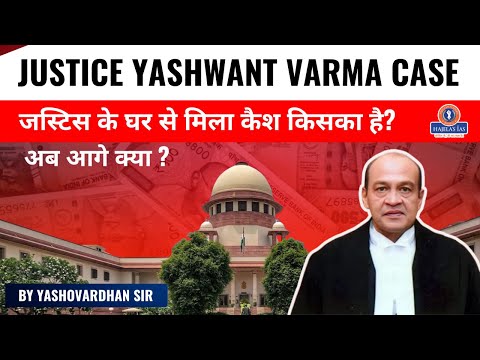
Justice Yashwant Verma Cash Recovered case

UPSC / MPPSC | Date: 22 March 2025
Incident:
On the night of Holi (around 11:30 PM on 14th March), a fire broke out at the residence of Delhi High Court Justice Yashwant Verma. Justice Verma was not present at home. His family called the fire brigade and local police. While extinguishing the fire, firefighters allegedly discovered a large amount of cash in one of the rooms. Some media reports suggested that part of the cash was already burning. The alleged amount was around ₹15 crore.
Senior Delhi Police officials informed their higher-ups, escalating the matter to the highest levels of government. Chief Justice of India (CJI) Sanjiv Khanna was immediately informed. He called for an urgent collegium meeting to discuss the issue.
Debate on Judicial Corruption:
The sensational recovery of a ‘stash of cash’ from Justice Verma’s residence triggered a nationwide debate on judicial corruption. The matter was raised in the Rajya Sabha, where Vice President and Chairman Jagdeep Dhankhar expressed concern over the delay in making the incident public. He pointed out that had it involved a politician, officer, or industrialist, action would have been swift.
On Congress leader Jairam Ramesh raising the issue, Dhankhar stressed the need for a transparent, accountable, and effective systemic response. He assured consultations with both the Leader of the House J.P. Nadda and Opposition Leader Mallikarjun Kharge to develop a mechanism for such discussions—unprecedented in Parliament.
Kapil Sibal's Statement:
Supreme Court Bar Association Chairman and MP Kapil Sibal said it was high time the Supreme Court took judicial corruption seriously.
Retired Justice S.N. Dhingra's View:
He asserted that the Supreme Court should allow filing an FIR against Justice Verma, emphasizing that no judge is above the law. “If a judge commits murder, will the Supreme Court stop the FIR?” he asked.
Allahabad High Court Bar Association Reaction:
Sources revealed that during the collegium meeting on Thursday, all five judges unanimously agreed to transfer Justice Verma back to Allahabad High Court, where he had served before being posted to Delhi.
However, on Friday, after the transfer decision was publicized, the Allahabad High Court Bar Association passed a resolution opposing the recommendation, stating:
"Allahabad High Court is not a dumping ground."
Important UPSC/MPPSC Concepts Explained:
1. What is the Collegium System?
The Collegium is a group of the Chief Justice of India (CJI) and the four senior-most judges of the Supreme Court.
Functions:
- Recommend appointments and transfers of Supreme Court and High Court judges.
2. How Does the Collegium Work?
- Supreme Court Judges: Recommended by the CJI and 4 senior judges.
- High Court Judges: Recommended by the High Court Collegium (Chief Justice + 2 senior-most judges) and approved by the Supreme Court Collegium.
- The government can return the proposal once, but if the Collegium reiterates, the government must comply.
3. Controversies and Criticism of the Collegium:
- Lack of transparency: No clarity on selection criteria.
- No political or public participation: Complete control rests with judges.
- NJAC (National Judicial Appointments Commission):
- Introduced in 2014 to replace the Collegium.
- Supreme Court declared it unconstitutional to preserve judicial independence.
4. Removal of a Supreme Court or High Court Judge (Impeachment Process):
- Governed by Article 124(4) and Article 217 of the Constitution.
- Grounds: Misbehavior or Incapacity.
Steps:
- Proposal with signatures from:
- 50 Rajya Sabha MPs or 100 Lok Sabha MPs.
- Investigation Committee:
- A Supreme Court judge
- A Chief Justice of a High Court
- An eminent jurist
- If charges are proven, both Houses must pass the motion with a two-thirds majority.
- President removes the judge.
Fact:
- No judge has ever been impeached in Indian history, though some have resigned during the process.
5. Case Study - Justice V. Ramaswami (First Impeachment Attempt):
- Accused of serious corruption and misuse of funds.
- Impeachment motion failed due to lack of two-thirds majority in Lok Sabha.
6. Judicial Reforms & Accountability:
Why Needed:
Lack of accountability weakens public trust in the judiciary.
Suggested Reforms:
✅ Transparent appointment rules.
✅ Annual asset declarations by judges.
✅ Judicial Complaint Mechanism (Independent Judicial Council).
✅ Fast-track courts and e-courts for speedy justice.
✅ Bring judiciary under RTI for transparency.
✅ Performance evaluation of judges.
✅ Review outdated laws for simplification.
Judicial Accountability Bill:
- Introduced in 2010 for setting judicial conduct standards but not passed yet.
7. Alternative Dispute Resolution (ADR) - Methods to Resolve Disputes Without Court:
|
Method
|
Meaning
|
|
Mediation
|
Neutral mediator helps both parties settle.
|
|
Conciliation
|
Friendly settlement between parties.
|
|
Arbitration
|
Arbitrator decides; binding on both parties.
|
|
Pre-litigation
|
Settlement before going to court.
|
Why Promote ADR and Lok Adalats:
- Reduces the burden on courts.
- Faster, cheaper justice, especially for rural and poor populations.
8. Global Examples of Judicial Accountability:
|
Country
|
Unique Features
|
|
UK
|
Judicial Appointments Commission ensures transparency.
|
|
USA
|
Senate hearings for judge appointments, Judicial Council monitors conduct.
|
|
Canada
|
Public complaints process, judges are publicly evaluated.
|
|
Australia
|
Judicial Commission monitors performance and conduct.
|
|
Japan
|
Public referendum every 10 years for Supreme Court judges.
|
9. Suggested Measures for India:
- Create a Judicial Complaints Authority.
- Annual asset declaration by judges.
- Time limits for case disposal.
- Digitization of courts.
- Strengthen ADR mechanisms and Lok Adalats.
✅ Conclusion:
Judicial reforms are crucial for:
✔️ Transparency in appointments.
✔️ Strong accountability mechanisms.
✔️ Easy public access to justice.
✔️ Fast-track and digital systems for timely justice.
Topic Related Videos ⬇️