Public Examinations (Prevention of Unfair Means) Amendment Bill, 2026
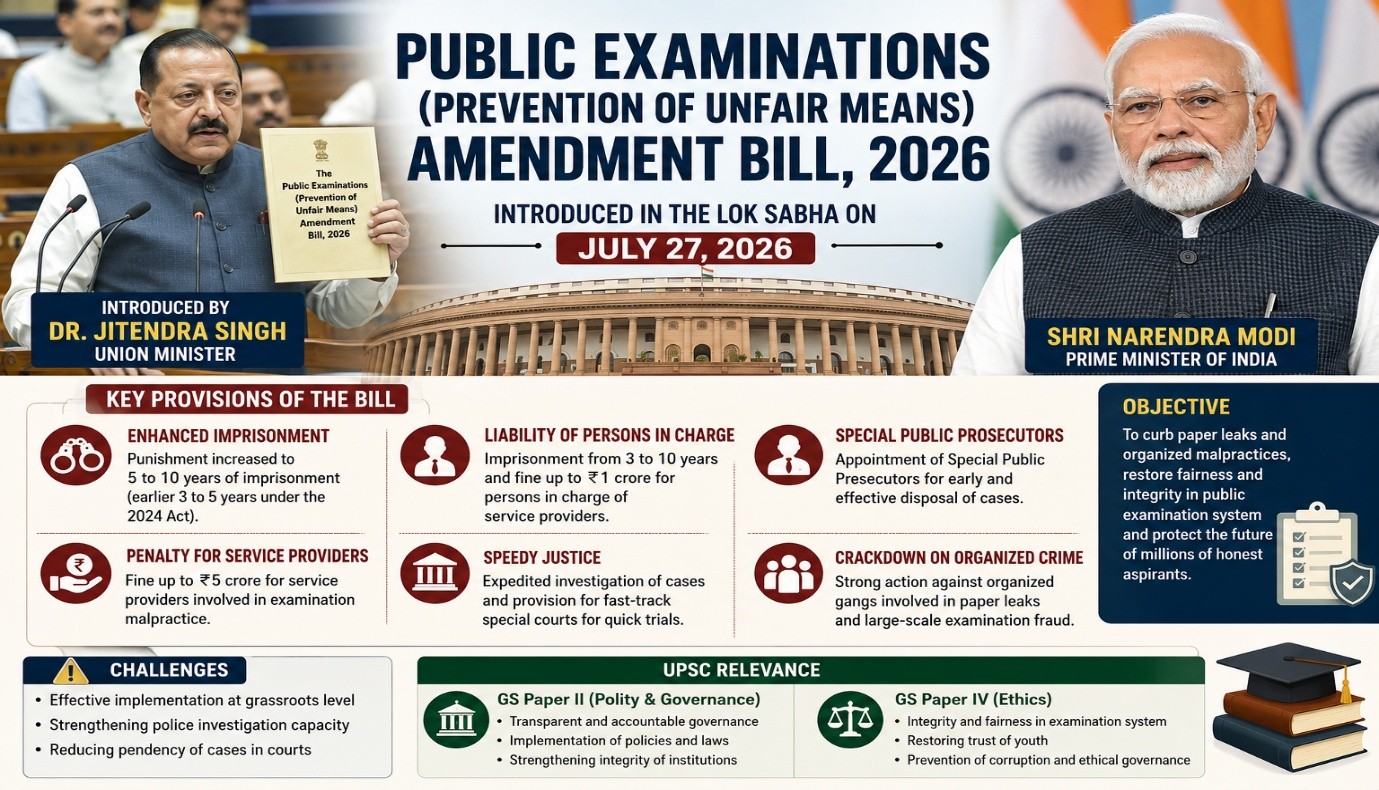
The Public Examinations (Prevention of Unfair Means) Amendment Bill, 2026 was introduced in the Lok Sabha on July 27, 2026, to strengthen measures against paper leaks and organized examination malpractice.
Key Provisions
- Introduced by: Union Minister Dr. Jitendra Singh in the Lok Sabha on July 27, 2026.
- Enhanced Imprisonment: The punishment has been increased to 5–10 years of imprisonment, compared to 3–5 years under the original Public Examinations (Prevention of Unfair Means) Act, 2024.
- Penalty for Service Providers: A fine of up to ₹5 crore for service providers involved in examination-related malpractice.
- Liability of Persons in Charge of Service Providers: Imprisonment ranging from 3–10 years and a fine of up to ₹1 crore.
- Speedy Justice: Provides for expedited investigation of cases and fast-track special courts for quick trials.
- Special Public Prosecutors: Appointment of Special Public Prosecutors to ensure the timely disposal of cases.
- Crackdown on Organized Crime: Targets organized gangs involved in paper leaks and large-scale examination fraud.
Challenges
Despite stricter legal provisions, key challenges remain:
- Effective implementation of the law at the grassroots level.
- Strengthening the investigative capacity of the police.
- Reducing the backlog of pending cases in courts.
UPSC Relevance
GS Paper II (Polity & Governance)
- Transparent and accountable governance.
- Implementation of public policies and legal reforms.
- Strengthening the integrity of public examination systems.
GS Paper IV (Ethics, Integrity & Aptitude)
- Integrity and fairness in the examination system.
- Restoring public trust, especially among youth.
- Preventing corruption and promoting ethical governance.
Topic Related Videos ⬇️

BHAVYA Rasayan Scheme
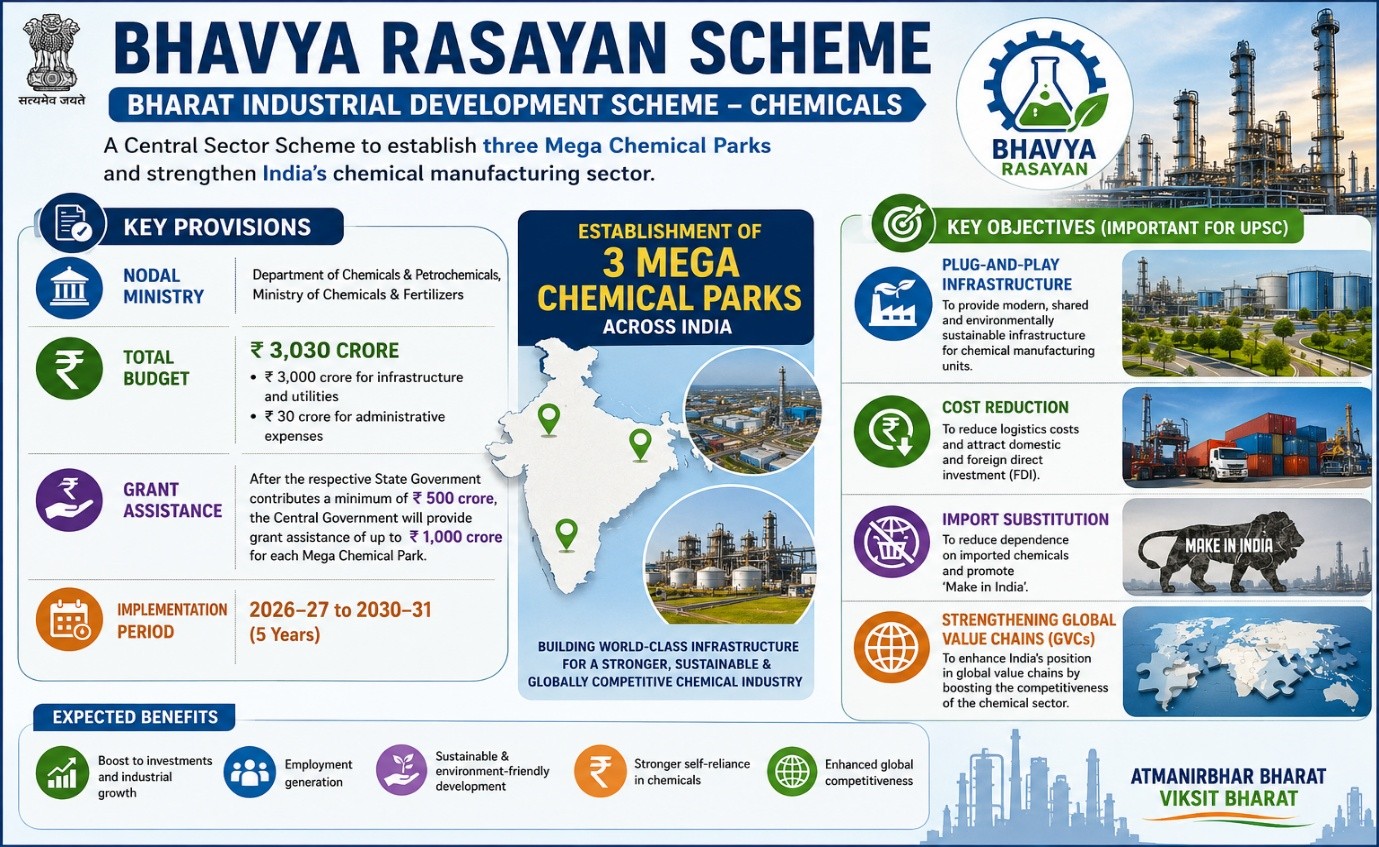
The BHAVYA Rasayan Scheme, officially known as the Bharat Industrial Development Scheme – Chemicals, is a Central Sector Scheme launched to establish three Mega Chemical Parks across the country and promote the growth of India's chemical manufacturing sector.
Key Provisions
- Nodal Ministry: Department of Chemicals and Petrochemicals, Ministry of Chemicals and Fertilizers.
- Total Budget: ₹3,030 crore, comprising:
- ₹3,000 crore for infrastructure and utilities.
- ₹30 crore for administrative expenses.
- Grant Assistance: After the respective State Government contributes a minimum of ₹500 crore, the Central Government will provide grant assistance of up to ₹1,000 crore for each Mega Chemical Park.
- Implementation Period: FY 2026–27 to FY 2030–31.
Key Objectives (Important for UPSC)
- Plug-and-Play Infrastructure: To provide modern, shared, and environmentally sustainable infrastructure for chemical manufacturing units.
- Cost Reduction: To reduce logistics costs and attract both domestic and foreign direct investment (FDI).
- Import Substitution: To reduce dependence on imported chemicals and promote the Make in India initiative.
Strengthening Global Value Chains (GVCs): To enhance India's position in global value chains by boosting the competitiveness of its chemical manufacturing sector.
Topic Related Videos ⬇️
