First Direct Commercial Freight Train from Kolkata Port to Biratnagar, Nepal
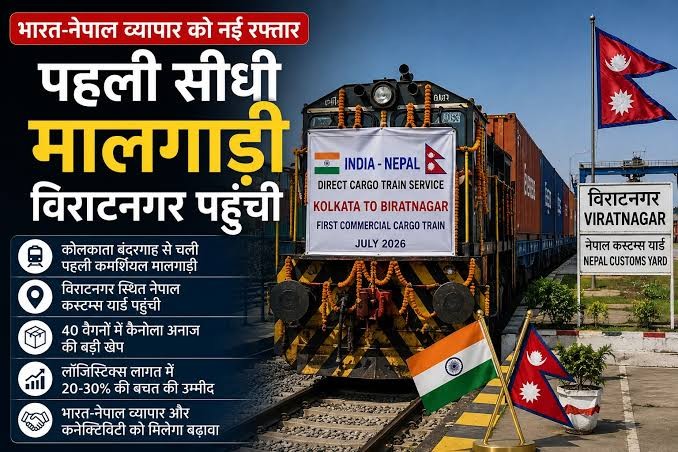
Giving a fresh boost to India–Nepal trade connectivity, the first direct commercial freight train from Kolkata Port reached the Biratnagar Customs Yard in eastern Nepal on 20 July 2026.
The freight train carried 40 forty-foot containers loaded with canola grain, and the service was operated by the Container Corporation of India Limited (CONCOR).
India–Nepal Rail Transit Arrangement
The freight train was operated under the revised India–Nepal Rail Transit Framework, which allows both containerized and bulk cargo to be transported directly to Biratnagar by rail. The service runs through the Jogbani–Biratnagar broad-gauge cross-border railway link.
This new arrangement will provide Nepalese industries with improved access to seaports while making the import and export process more efficient and cost-effective.
Protocol Amendment and Bilateral Cooperation
The direct rail service is based on the Letter of Exchange signed on 13 November 2025. Through this agreement, the Protocol to the India–Nepal Transit Treaty was amended, enabling direct rail transportation of goods to Biratnagar.
Previously, Birgunj was the only customs point in Nepal where cargo from Indian ports, including third-country imports, could be transported by rail. The amendment has now extended this facility to Biratnagar.
Benefits for Trade and Logistics
The new rail service is expected to reduce transportation costs for Nepalese industries by 20–30%. As a landlocked country, Nepal relies on India's railway and port infrastructure to access global seaports and facilitate international trade.
The launch of direct rail connectivity to Biratnagar, one of Nepal's major industrial hubs, is expected to enhance trade activities, reduce cargo transit time, improve supply chain efficiency, and further strengthen the economic partnership between India and Nepal.
Topic Related Videos ⬇️

Superalloy Plant in Telangana to Strengthen India's Aerospace Manufacturing
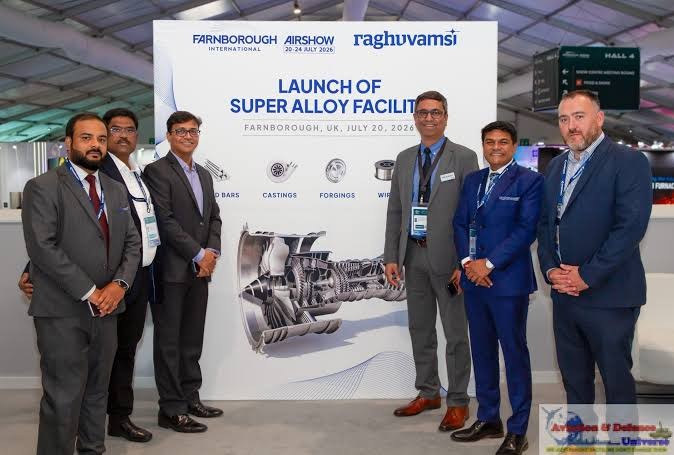
The Raghu Vamsi Aerospace Group has announced the establishment of a ₹600 crore integrated superalloy manufacturing facility in Telangana. The project will be among the few facilities in India capable of producing nickel-based superalloys through an integrated manufacturing process. It is considered a significant step toward strengthening the domestic supply chain for the aerospace and defence sectors.
Project Size and Production Capacity
The proposed manufacturing complex will be developed over 50 acres and will have an annual production capacity of approximately 5,000 tonnes. It will manufacture products such as round bars, wires, forgings, castings, and tungsten carbide powder.
These materials are widely used in high-temperature and high-pressure industrial applications, particularly in sectors where exceptional strength, durability, and reliability are essential, such as aerospace, defence, power generation, and advanced engineering.
Strategic Industrial Location Near Hyderabad
The integrated manufacturing facility will be established in the Hardware Park near Hyderabad International Airport. This region of Telangana is already recognized as a major industrial hub, and the new project is expected to further strengthen the state's aerospace manufacturing ecosystem.
According to the company, commercial production is targeted to commence in January 2028.
Leadership, Investment, and Industrial Significance
The project will be led by Dr. S. K. Jha, former Chairman and Managing Director of Mishra Dhatu Nigam Limited (MIDHANI).
Earlier, on 20 July 2026, the Raghu Vamsi Aerospace Group raised US$40 million (approximately ₹400 crore) in funding, led by Norwest and Skagen Asset Management. The investment will support the company's plans to expand its manufacturing capabilities and strengthen its presence in the strategic metals and advanced materials sector.
The project is expected to reduce India's dependence on imported high-performance alloys, enhance indigenous manufacturing capabilities, support the Make in India and Atmanirbhar Bharat initiatives, and improve the country's competitiveness in the global aerospace and defence supply chain.
Topic Related Videos ⬇️